
Santa Clarita Vinyl Fence: Project example: a 12-foot vinyl double drive gate with a short privacy run, opening a Newhall side yard to RV parking — what it looks like and what it costs
Santa Clarita Vinyl Fence sets out a typical side-yard access project for an older single-story home in Newhall: a narrow wood gate and a stretch of fence along the driveway replaced with a 12-foot white vinyl double drive gate and 40 feet of 6-foot privacy fence, so a travel trailer can back from the street straight onto a concrete pad beside the house.
Project Examples & Typical Prices
Worked example. The pictures are AI concept illustrations, not photographs; no installation was performed or arranged through this site; prices are typical Santa Clarita Valley market ranges, not quotes.
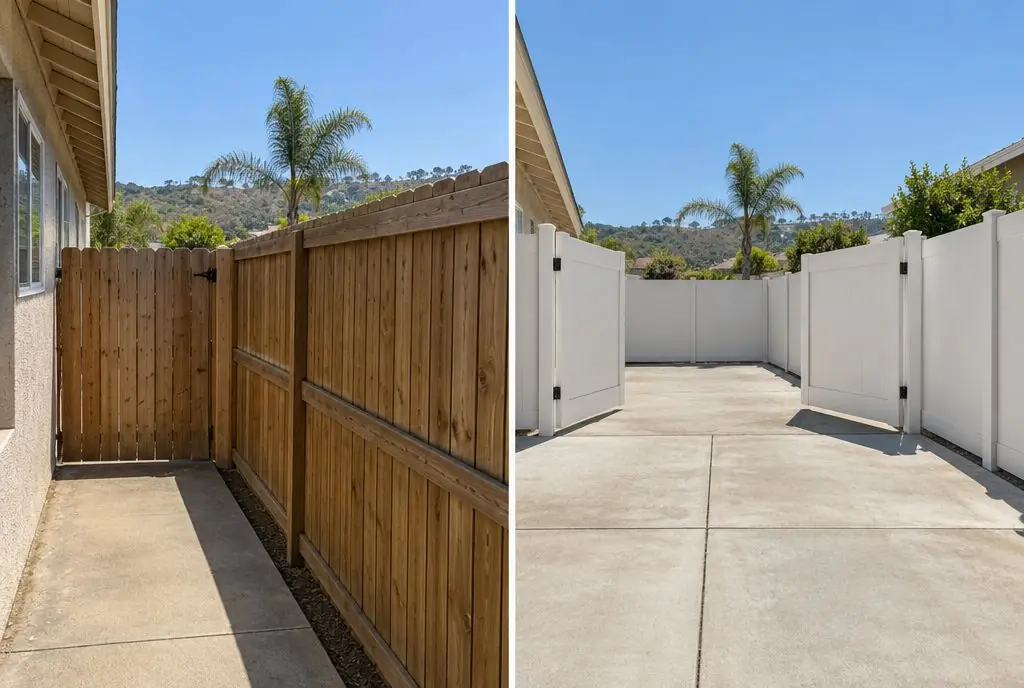 Illustration
Starting pointFinished layout (concept)
Illustration
Starting pointFinished layout (concept)
The scenario
The house is one of the older single-story homes on the wide lots around Newhall's established streets, where a driveway runs down the side of the house to a detached garage and the strip beside it is wide enough for a trailer. A 4-foot wood gate and 40 feet of weathered wood fence currently separate the front driveway from the side yard, and the owner has poured a concrete pad behind that fence to park a 24-foot travel trailer. The pad is reachable only if the gate opening grows to 12 feet clear and the fence either side is rebuilt to match.
The brief is a 12-foot white vinyl double drive gate, two 6-foot leaves that swing inward onto the side yard, with 6-foot privacy fence on either side to fill the 40-foot run from the house corner to the garage wall. The driveway is sloped slightly toward the street, which affects where the leaves can swing, and the ground on the side-yard side is compacted decomposed granite. A drop rod and ground sleeve are needed so the leaves stay put when the trailer is not there, and the gate must open wide enough that the trailer's awning side clears the posts.
The numbers that set the gate:
- Trailer: about 24 feet long, with an awning on one side
- Clear opening: 12 feet, as two 6-foot leaves
- Swing: inward onto the side yard, away from the sidewalk
- Fence either side: 40 feet of 6-foot privacy from the house corner to the garage wall
- Ground: driveway sloping toward the street, compacted DG behind the gate
What the job involves
- The installer measures the trailer's width and the pad's position, lays out a 12-foot clear opening centered on the pad's approach, and checks the swing arc of two 6-foot leaves against the driveway slope and the house wall.
- The old wood gate and fence are removed, the posts are dug out with their footings, and the run is cleared from the house corner to the garage; utility marking confirms the gas line to the garage is clear of the gate posts.
- The two gate posts are set first: holes 12 inches wide and 42 inches deep, each post fitted with an internal steel or heavy aluminum reinforcement, filled with concrete and plumbed precisely so the leaves hang square to each other.
- Line posts for the privacy panels are set at 8-foot centers from the gate posts outward to the house and garage, with a short custom panel at each end; holes are 30 inches deep in the DG.
- Once the concrete cures, the privacy panels are assembled with aluminum-insert bottom rails, and the two welded-frame gate leaves are hung on heavy-duty adjustable hinges; a drop rod on the fixed leaf seats into a sleeve set in a small concrete pad in the driveway, and a latch bar joins the leaves.
- The leaves are adjusted so they meet in the middle with an even gap, swing without scraping the driveway's crown, and hold open on a pair of gate stops; caps go on, and the driveway and side yard are swept clean.
Hardware and materials
- Two reinforced 5-by-5 gate posts with internal steel inserts, set in 42-inch concrete footings
- A 12-foot white vinyl double drive gate as two 6-foot welded aluminum-framed leaves with privacy infill to match the fence
- Heavy-duty adjustable hinges, a drop rod with ground sleeve, a center latch bar, and two gate stops or hold-opens
- 5-by-5 line posts, aluminum-insert bottom rails, top rails and tongue-and-groove pickets for 40 feet of 6-foot privacy panels
- Auger with 10-inch and 12-inch bits, demolition hammer for the old footings, concrete and gravel, string line, post levels and braces
- Flat caps and vinyl-safe adhesive; a small form for the drop-rod sleeve pad
What it typically costs in the Santa Clarita Valley
| 6 ft solid privacy, 40 linear feet installed ($38–$58 per foot) | $1,520–$2,320 |
| Double drive gate (10–12 ft) | +$1,100–$2,200 |
| Typical total | $2,620–$4,520 (market range, not a quote) |
These are typical local ranges, not a quote or an offer; an installer prices the actual job after seeing the wall.
Add-ons often paired with this job
- Single walk gate (4 ft) — +$350–$650. A 4-foot walk gate next to the double gate is the usual add-on, so nobody has to swing a 6-foot leaf to reach the trash cans.
- Decorative post caps (per run) — +$60–$180. Decorative caps on the gate posts are a visible upgrade on a street-facing gate.
- Tan, gray or woodgrain vinyl instead of white — +$300–$900. A tan or gray gate can match an existing colored fence further down the line, at a material surcharge.
Why it is done this way
A double drive gate is the hardest-working piece of a vinyl fence, which is why its posts are built differently from the rest. Two 6-foot leaves put a long lever on each hinge post, and vinyl alone cannot hold that without sagging, so the posts are reinforced with metal inside, set deeper than any line post, and surrounded by far more concrete. The welded frame inside each leaf does the same job for the gate itself, keeping it square over years of opening and closing.
The drop rod and ground sleeve are what let a double gate work as a secure closure rather than two swinging panels. One leaf pins to the ground, the other latches to it, and a padlock through the latch bar locks both. Swinging the leaves inward keeps them off the public sidewalk and the driveway apron, which is also what the city expects of a street-facing gate. Vinyl privacy infill either side matches the gate so the whole run reads as one fence from the street.
What keeps a 12-foot gate from sagging over time:
- metal reinforcement inside both hinge posts
- 42-inch footings with more concrete than any line post
- a welded aluminum frame inside each leaf
- a drop rod that takes the fixed leaf's weight off its hinges when closed
What would change the price
- The opening needs to be 14 or 16 feet for a wider motorhome — larger leaves, heavier posts and sometimes a steel frame instead of aluminum move the gate line up.
- The driveway slope means the leaves cannot swing inward without hitting grade — rising hinges or a lift-off design add hardware.
- A third post and a walk gate are added beside the double gate — another reinforced post and a separate gate option.
- The gate is automated later — an opener needs power and a different post setup, and it is priced by a gate-automation installer.
- The old gate posts turn out to be steel pipe in large footings — breaking them out takes longer than a wood post removal.
Where this leads
- Service page: Vinyl Double Drive Gates — 10–16 ft double gates on steel-cored posts for RV pads and side-yard vehicle access, framed so the leaves stay square.
- Local page: Vinyl fence installation in Newhall
- All services and typical prices: vinyl fence installation in Santa Clarita
- More worked examples: Project Examples & Typical Prices
Check availability and the price range for this setup
Bookings aren't open yet — describe the fence line and you get a Santa Clarita price range right here. Per-foot ranges are typical Santa Clarita Valley installed prices for white vinyl, materials and labor. This is a market estimate, not a quote; footage is measured on site and the installer prices the actual job. City permit fees and HOA fees, where they apply, are not included.