
Santa Clarita Vinyl Fence: Vinyl Fence Installation on Retaining Walls in Santa Clarita
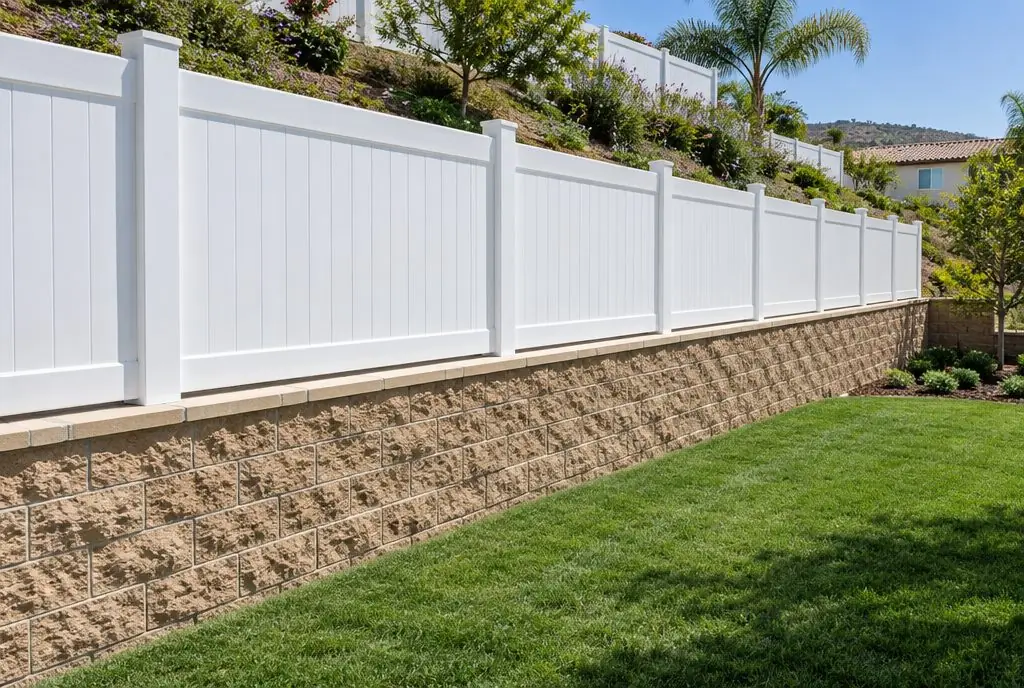
Santa Clarita Vinyl Fence covers vinyl fence installation on and behind block retaining walls across the Santa Clarita Valley — the terraced pads of Happy Valley, Northbridge, Fair Oaks Ranch and Stevenson Ranch — where the installer core-drills steel posts into the wall cap or sets posts in the soil behind it, and keeps the combined wall-and-fence height inside the rules measured from the lower side.
 Illustration
Three ways to put a fence on a block wall
Core-drilled posts: a 3 inch hole is cored through the cap block into the grouted cell, a galvanized steel post is epoxied or grouted in, and a vinyl 5x5 sleeve slides over it. Cleanest look, needs a wall with grouted cells. Surface-mounted posts: a steel base plate anchored to the cap with four wedge anchors; for low 3–4 ft picket fences only, since a solid 6 ft panel levers the plate loose in wind. Posts behind the wall: new footings dug 12–18 inches behind the wall face in the retained soil; works on any wall, adds a few inches of offset, and keeps the drilling off a wall that is not in good shape.
| Method | Works on | Suits | Trade-off |
|---|---|---|---|
| Core-drilled steel posts | 8 in block walls with grouted cells | 4–6 ft privacy and semi-privacy | Needs sound grout; post spacing follows the cells |
| Surface-mounted base plates | Any solid cap at least 8 in wide | 3–4 ft picket only | Plates lever loose under a solid 6 ft panel |
| Posts behind the wall | Any wall, any condition | Every style | Fence sits a few inches back from the wall face |
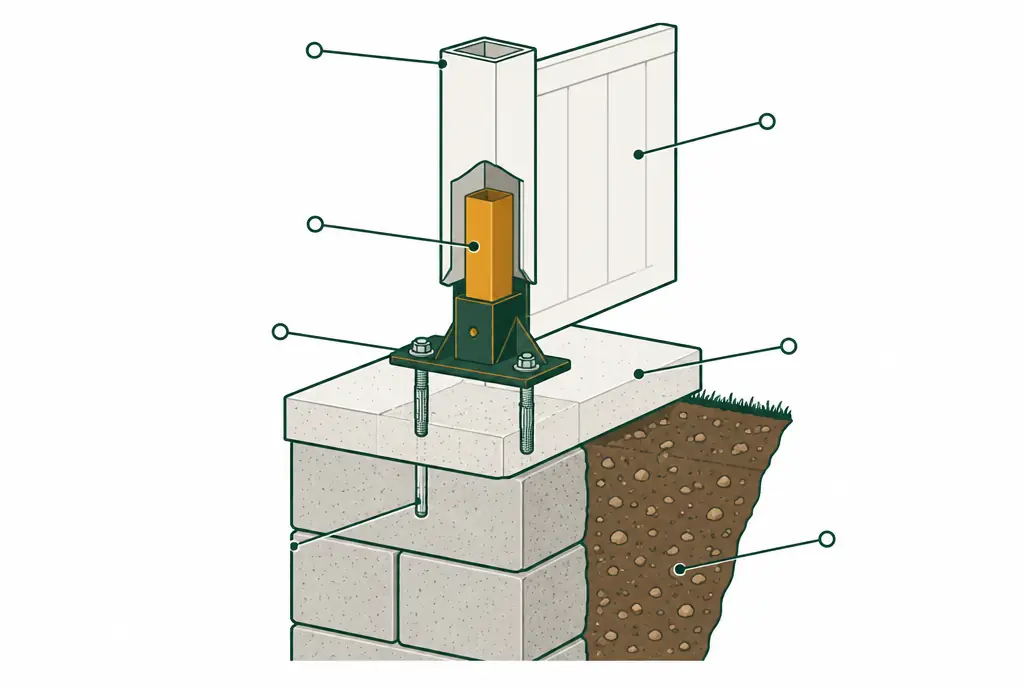
What the callout markers point to
- Anchors go into solid block or the concrete cap, never into a mortar joint or the face of a hollow cell.
- The post slides over the bracket's upright so no fastener shows on the face of the vinyl.
- A wall-top fence is usually lower than a ground-set one; the combined wall and fence height is what the rules count.
Core-drilling and steel posts in the wall cap
Finding the grouted cells
Retaining walls in SCV tracts are 8 inch CMU with vertical rebar and grout every 16–32 inches. The installer locates the grouted cells with a rebar scanner or test drilling so each post lands in solid grout, not a hollow cell.
Embedment
The steel post goes 18–24 inches into the wall, set in a non-shrink grout or structural epoxy, and the vinyl sleeve is capped. Spacing follows the cells, which usually means 6 ft or 8 ft centers.
Wind and height
A 6 ft solid panel on top of a 4 ft wall is a 10 ft sail from the neighbor's side. Steel posts rated for the load and 6 ft spacing are standard; semi-privacy is the better panel on an exposed wall top.
Height rules when wall and fence stack
Both the city and the county measure fence height from the lower adjacent grade, so a 3 ft wall plus a 6 ft fence is a 9 ft fence to the downhill neighbor. The usual allowance is 6 ft of fence above a retaining wall when the combination serves as the boundary fence on a graded pad, with taller combinations typically needing a permit, and HOA guidelines in Stevenson Ranch and Valencia often cap the total. The installer checks the lot's grading plan and the association's rule before ordering 6 ft panels for a wall top; a 4 or 5 ft panel is the common compromise.
A 6 ft fence on a 4 ft wall is a 10 ft sail from the neighbor's side.
Drainage, surcharge and when an engineer is needed
A fence adds wind load to the top of a retaining wall, which the original engineer may not have assumed. On walls under 4 ft retaining a flat pad this is routine. On walls over 4 ft, walls with a slope above them, walls that are already leaning or cracked, and walls with no weep holes, a soils or structural engineer's letter is the right step before drilling — and the installer will say so rather than drill into a wall that is already working hard. Posts set behind the wall keep weep holes and drainage gravel undisturbed.
Vinyl Fence on a Retaining Wall — common questions
Can a fence go on a wall that is only 6 inches wide?
A 6 inch cap is too narrow for a 5x5 vinyl post. The steel post is cored through the cap into the block below, and the vinyl sleeve overhangs the cap slightly, or the fence goes behind the wall.
Who owns the wall between two lots?
On graded tract pads the retaining wall usually sits on the uphill lot's side of the line and belongs to that owner; the HOA's fence exhibit or the lot's grading plan shows it. Fence posts go on the owner's side.
Vinyl Fence on a Retaining Wall: check availability and price range
Bookings aren't open yet — describe the fence line and you get a Santa Clarita price range right here. Per-foot ranges are typical Santa Clarita Valley installed prices for white vinyl, materials and labor. This is a market estimate, not a quote; footage is measured on site and the installer prices the actual job. City permit fees and HOA fees, where they apply, are not included.