
Santa Clarita Vinyl Fence: Vinyl Fence Installation on Sloped Lots in Santa Clarita
Santa Clarita Vinyl Fence covers vinyl fence installation on sloped and stepped lots across the Santa Clarita Valley — the falling side yards of Plum Canyon, Fair Oaks Ranch, Happy Valley and Val Verde and the pad edges above slope easements — where the installer decides between stepping level panels and racking the rails, and closes the gap under the fence so dogs stay in and the line looks intentional.
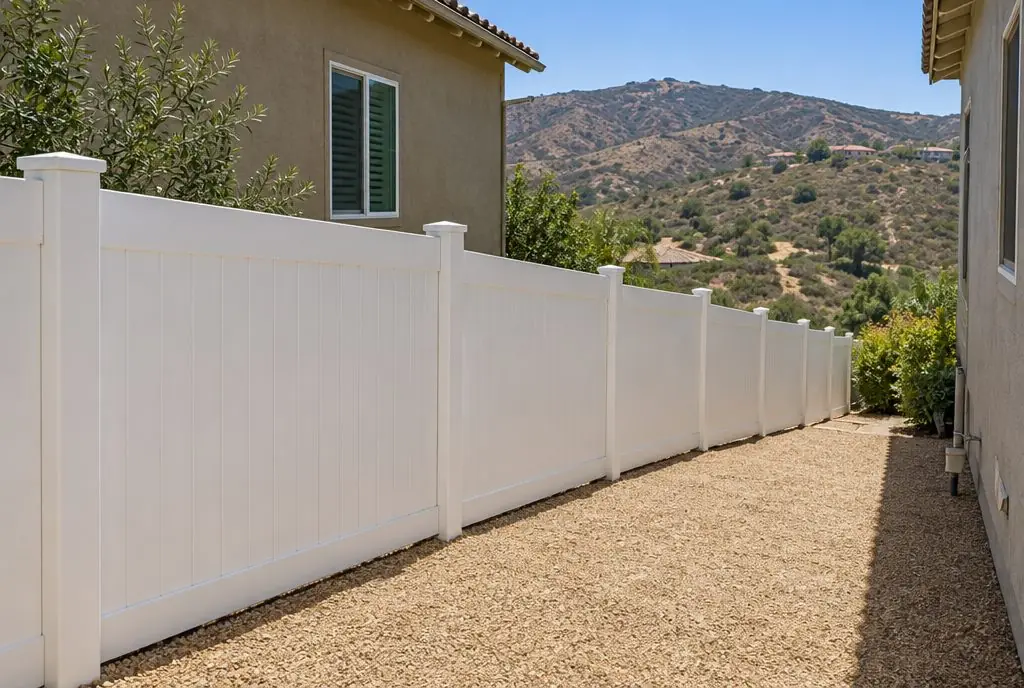 Illustration
Stepping versus racking: how the grade decides
Racking tilts the rails to follow the ground while the posts stay plumb. Ranch rail and open picket panels rack up to about 10–15 degrees because the pickets or rails can pivot in oversized routes. Stepping keeps every panel level and drops the next panel down at the post, like stairs. Solid tongue-and-groove privacy does not rack more than a degree or two, so on any real slope it steps. The installer measures the fall over the run with a laser; under 6 inches per 8 ft panel a picket fence racks, anything steeper or any privacy fence steps.
| Fall per 8 ft panel | Picket or ranch rail | Solid privacy |
|---|---|---|
| Up to 2 in | Set level or rack slightly | Set level, trim the bottom |
| 2–6 in | Rack the rails with the grade | Step each panel |
| 6–12 in | Step, or rack with closer posts | Step with 6 ft sections |
| Over 12 in | Step with 4–6 ft sections | Step with 4 ft sections or terrace the line |
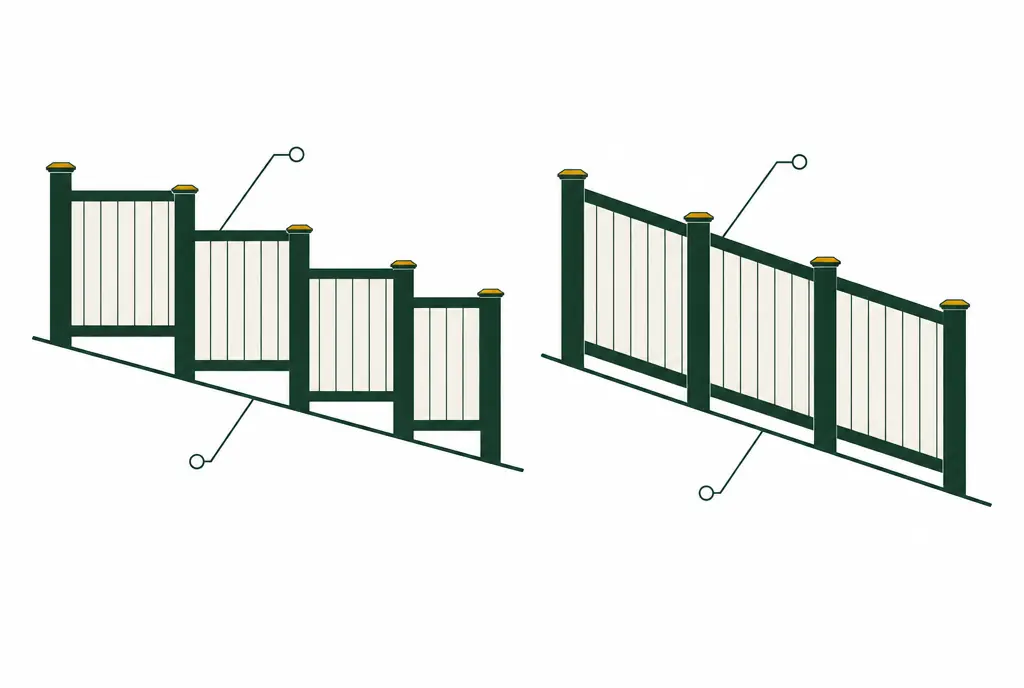
What the callout markers point to
- Stepped: every panel stays level and each post drops by the same amount; triangular gaps are closed with a kick board.
- Racked: the rails tilt to follow the ground, the pickets stay vertical, and the top line runs continuous.
- Each panel has a racking limit; beyond it the installer steps instead.
Laying out steps so they look intentional
Equal steps are what make a hillside fence look designed rather than improvised.
Equal steps, consistent spacing
The total fall is divided by the number of panels so every step is the same — 4, 6 or 8 inches — rather than one big drop where the ground happens to break. Posts go at 6 ft centers so steps stay small.
Top line from the high end
The run starts at the top corner at full height and steps down; at the low end the installer confirms the fence still clears the 6 ft limit measured on the high side of the neighbor's grade.
Longer posts on the low side
Each post is cut to carry the taller of its two panels; stepped runs use 9 ft posts where an 8 ft line post would come up short.
Closing the bottom gap on a stepped run
A stepped panel leaves a wedge under the low end of each section. Options, cheapest first: a trimmed tongue-and-groove picket cut to the ground line and slid into a bottom rail that is dropped lower on that end; a short vinyl kick board; or a 4–8 inch concrete or block mow curb poured along the line, which also stops erosion on the slope. For dog yards the gap is held to 2 inches; on a plain property line 4 inches is acceptable.
Posts, concrete and slope easements
Posts on a slope go in at the same 24–30 inch depth measured from the downhill side, since that is the side that resists a lean. On the cut-and-fill pads of Canyon Country and Saugus the fill side augers easily and the cut side hits sandstone, so the same run can need a rock bit for half its holes. Where the lot ends at a slope easement, the fence goes along the pad edge rather than down the bank; building on the bank disturbs engineered slope and in HOA tracts is usually prohibited outright.
Vinyl Fence on a Slope (Stepped & Racked) — common questions
How much extra does a sloped yard add to a vinyl fence?
About $4–$9 per foot in 2026 for the layout, longer posts, trimmed pickets and the extra time per hole; a 100 ft stepped side yard adds roughly $400–$900 over a flat one.
Can the fence follow a curve as well as a slope?
Gentle curves, yes — vinyl panels are straight, so a curve becomes a series of short panels with the posts at angles. Each angle post is a routed corner or a post with field-cut routes, and 4 ft panels make the curve read smoothly.
Vinyl Fence on a Slope (Stepped & Racked): check availability and price range
Bookings aren't open yet — describe the fence line and you get a Santa Clarita price range right here. Per-foot ranges are typical Santa Clarita Valley installed prices for white vinyl, materials and labor. This is a market estimate, not a quote; footage is measured on site and the installer prices the actual job. City permit fees and HOA fees, where they apply, are not included.