
Santa Clarita Vinyl Fence: Vinyl Privacy Fence Installation in Santa Clarita
Santa Clarita Vinyl Fence covers 6 ft vinyl privacy fence installation across the Santa Clarita Valley — side yards, rear lines and pool-side screening — where the installer sets 5x5 routed posts in concrete, hangs reinforced rails and tongue-and-groove pickets with room to expand, and chooses post spacing for the wind the lot actually gets.
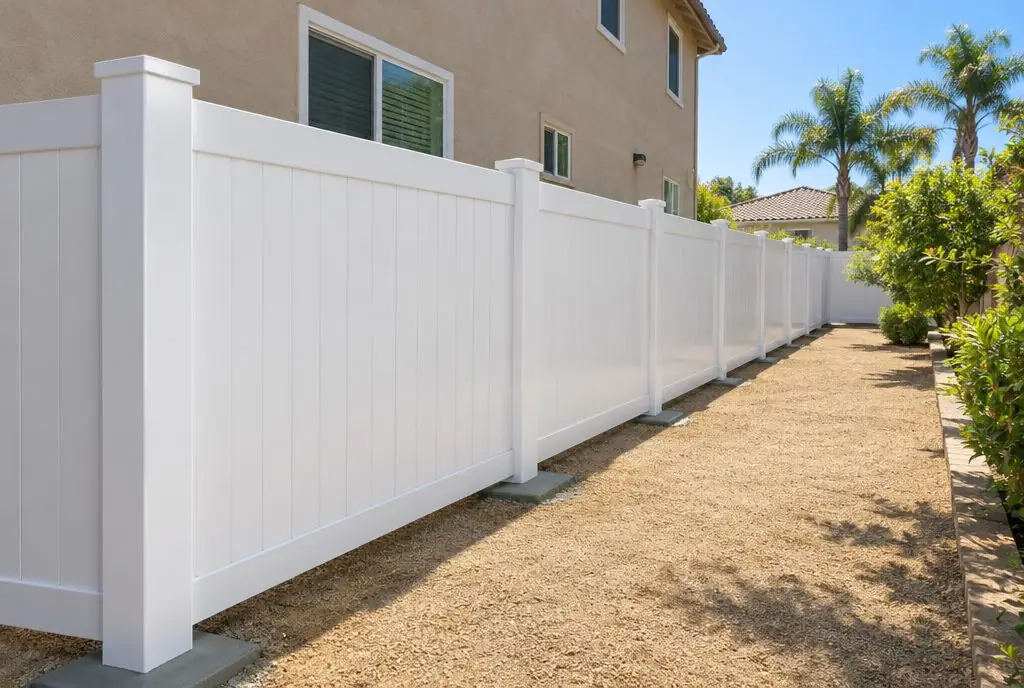 Illustration
What a 6 ft vinyl privacy fence is built from
A privacy fence is a system, not a pile of panels. Before any hole is dug the line is called in to 811 (DigAlert), which is free and required. Each 6 ft or 8 ft section has two or three horizontal rails that slide into routed holes in the posts, and 6 inch or 12 inch wide tongue-and-groove pickets that lock edge to edge between the rails so there is no gap to see through. The grades that last in Santa Clarita sun are virgin (not recycled) PVC with a titanium dioxide cap stock for UV resistance, made to the ASTM F964 fence standard, with wall thicknesses around 0.135–0.150 inches on posts and 0.065–0.090 inches on pickets.
| Component | Typical spec on a 6 ft privacy fence | Why it matters |
|---|---|---|
| Line posts | 5x5 routed, 8 ft long, about 0.135–0.150 in wall | Carries the panel in wind; 4x4 is undersized at 6 ft |
| Gate, end and corner posts | 5x5 with a galvanized steel insert or concrete fill | Takes gate swing and the pull of the run |
| Bottom rail | 2x6 profile with an aluminum or steel channel | Holds the picket weight without sagging |
| Top rail | 2x3.5 profile | Caps the pickets and locks the panel |
| Pickets | Tongue-and-groove, 6 or 12 in wide, about 0.065–0.090 in wall | No see-through gaps, room to expand |
| Footing | 10–12 in wide, 24–30 in deep, two to three 60 lb bags | Keeps the post plumb through Santa Ana seasons |
| Section width | 6 ft on exposed lots, 8 ft on sheltered ones | Shorter sections mean more posts sharing the load |
Posts: 5x5, routed, capped
A 6 ft solid fence belongs on 5x5 posts, not 4x4. Line posts are 8 ft long (2–2.5 ft in the ground, 6 ft out), with rail routes cut at the factory so the rails cannot pull out. Every post gets an external cap glued on so water and wasps stay out.
Rails: 2x6 bottom with a metal insert
The bottom rail carries the weight of the pickets, so it is a 2x6 profile with an aluminum or galvanized steel channel inside. The top rail is a lighter 2x3.5 profile. Mid rails are added on 8 ft sections and in wind-exposed runs.
Pickets: tongue-and-groove with expansion room
T&G pickets slide into the bottom rail, interlock, and are capped by the top rail. The installer leaves room for movement at the rail ends, because white vinyl expands and contracts noticeably between winter mornings and summer afternoons.
How the posts are set in Santa Clarita soil
Holes are augered 10–12 inches in diameter and 24–30 inches deep — deeper on exposed Canyon Country and Castaic lots, shallower only where sandstone stops the bit and a steel stub is epoxied in instead. Each post takes two to three 60 lb bags of concrete, poured and rodded so the post is plumb in both directions and crowned at the top so water runs away from the vinyl. Gate, end and corner posts get a galvanized steel insert or a concrete fill before the concrete goes in. The crew lets the concrete cure overnight before hanging panels, which is why a typical job is two site days with a day between them.
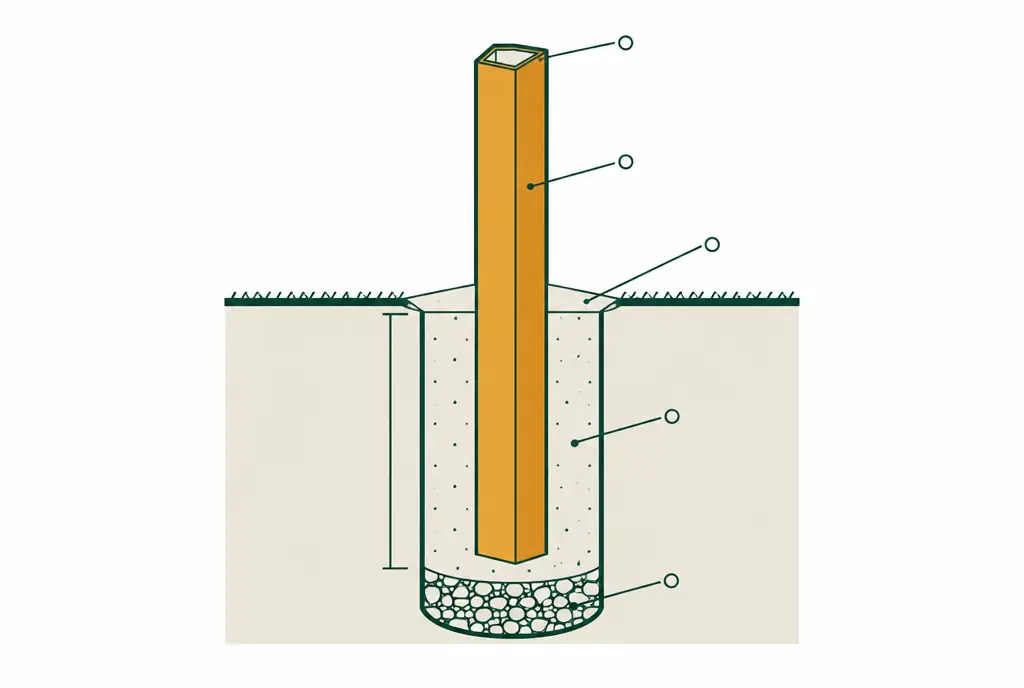
What the callout markers point to
- The hole is augered wider than the post so concrete surrounds it on every side.
- Gravel at the bottom lets water drain away from the hollow post instead of pooling.
- The top of the footing is sloped so rain sheds off instead of sitting against the vinyl.
Panel widths, wind and the 6 ft versus 8 ft question
Vinyl privacy fence is sold in 6 ft and 8 ft sections. The 8 ft section uses fewer posts and costs a little less per foot, and it is fine on a sheltered Valencia side yard. A 6 ft solid panel is still a sail, and in the Santa Ana corridor through Canyon Country, the Castaic lake tracts and the ridgeline streets of Saugus the installer will push for 6 ft spacing, 30 inch footings and steel inserts in the posts at the ends of each run. The cost difference is a few dollars a foot; in a 60 mph gust it is often the difference between a fence that stands and one that does not.
The cost difference between a fence built for the wind and one that is not is a few dollars a foot; in a 60 mph gust it is often the difference between a fence that stands and one that does not.
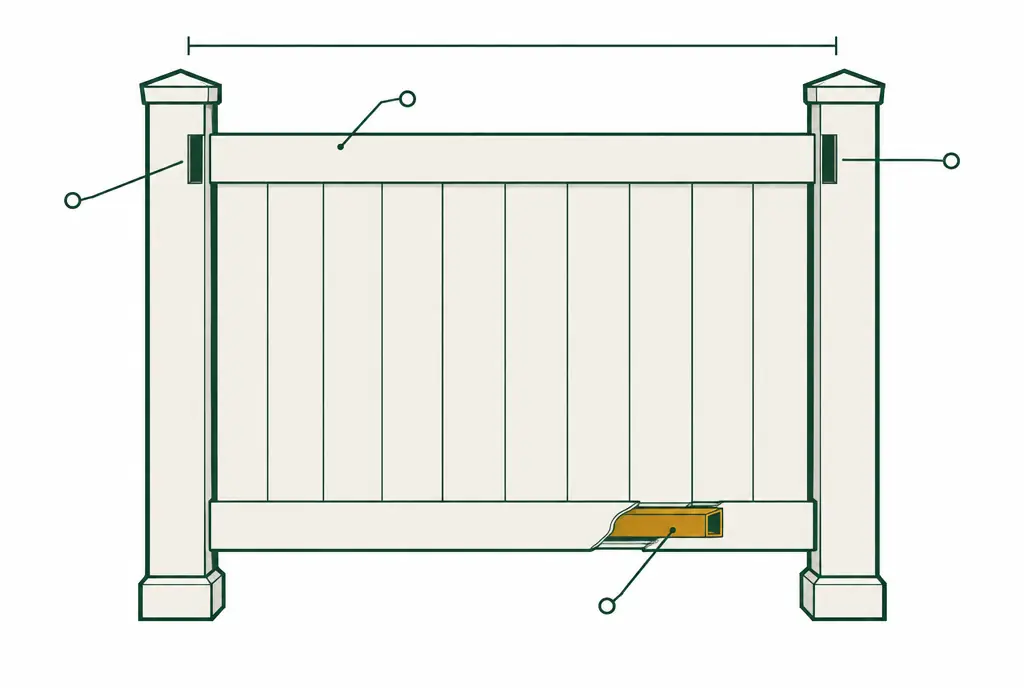
What the callout markers point to
- Privacy panels are built on 8-foot centers; pool fences often use closer spacing to keep pickets stiff.
- The aluminum insert keeps the bottom rail from sagging across the bay in summer heat and wind.
- Rails pass into routed openings in the post and lock with internal tabs; no screws show on the face.
Why rails are never glued and gaps are left on purpose
The most common DIY failure is glue. Rails and pickets expand and contract with temperature; a rail glued into a post route has nowhere to go and either bows the panel or cracks the post. Proper installs rely on the routed post, notched rail ends or rail-lock clips to hold the rail mechanically while letting it move. The only glue on the job is on the post caps.
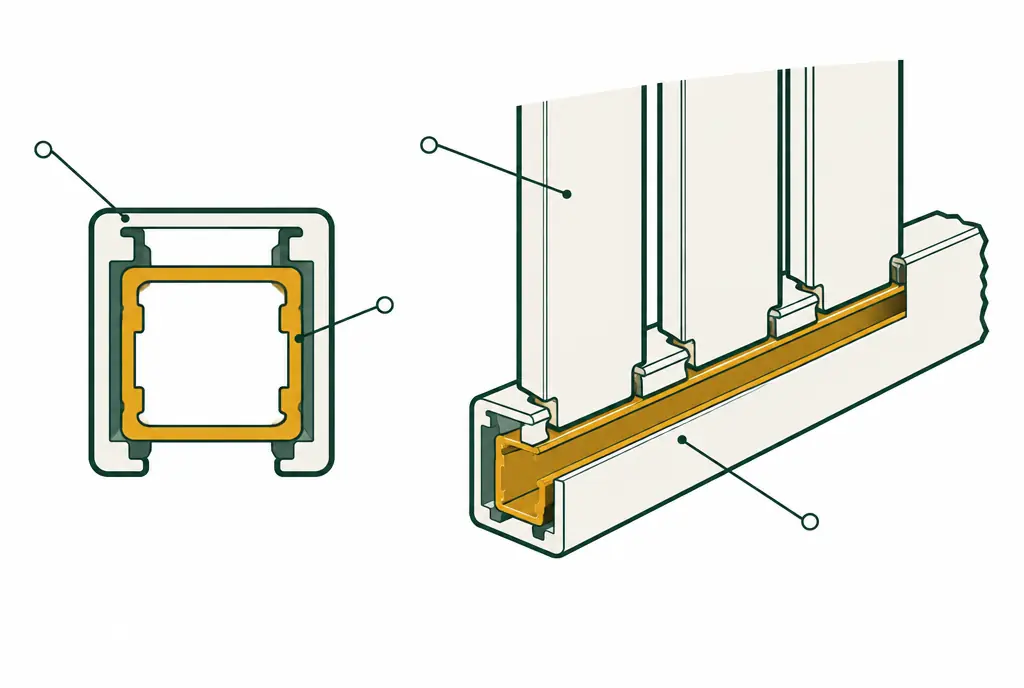
What the callout markers point to
- The insert runs the whole length of the rail and bears inside the post at each end.
- Without it an 8-foot privacy bay bows under the weight of the pickets in summer heat.
- Top rails on tall fences and gate rails are sometimes reinforced the same way.
Where a privacy fence fits on a Santa Clarita lot
A 6 ft solid vinyl panel suits these spots on a typical Santa Clarita lot:
- Side yards between neighbors — the classic tongue-and-groove run from the house to the rear corner.
- Rear lines on flat pads — where there is no slope easement or view corridor behind the yard.
- Pool-side screening — blocking the view from a neighbor's second-story windows.
- Dog-run enclosures — no gaps to squeeze through and a smooth face to climb.
It is the wrong choice at the front setback, where height is typically capped at 42 inches; on HOA view lots that require open fencing; and along the top of a slope easement, where a stepped layout or a semi-privacy panel does better.
Vinyl Privacy Fence Installation — common questions
How much does a 6 ft vinyl privacy fence cost per foot in Santa Clarita?
About $38–$58 per linear foot installed in 2026, white, materials and labor, on a flat lot with clear access. Slopes, old-fence removal, rocky soil, gates and colors add to that; the price range tool on the home page runs the math for a specific yard.
Can the pickets be seen through at all?
No. Tongue-and-groove pickets overlap, so there is no gap even after years of expansion. Semi-privacy styles with a lattice or spindle top are the choice when a little airflow or light is wanted.
Will a privacy fence need paint?
Never. Color runs through the material and the cap stock resists UV. It cleans with a hose and, for mildew on the shaded side, a mild vinegar and water mix.
Vinyl Privacy Fence Installation: check availability and price range
Bookings aren't open yet — describe the fence line and you get a Santa Clarita price range right here. Per-foot ranges are typical Santa Clarita Valley installed prices for white vinyl, materials and labor. This is a market estimate, not a quote; footage is measured on site and the installer prices the actual job. City permit fees and HOA fees, where they apply, are not included.