
Santa Clarita Vinyl Fence: Vinyl Pool Fence Installation in Santa Clarita
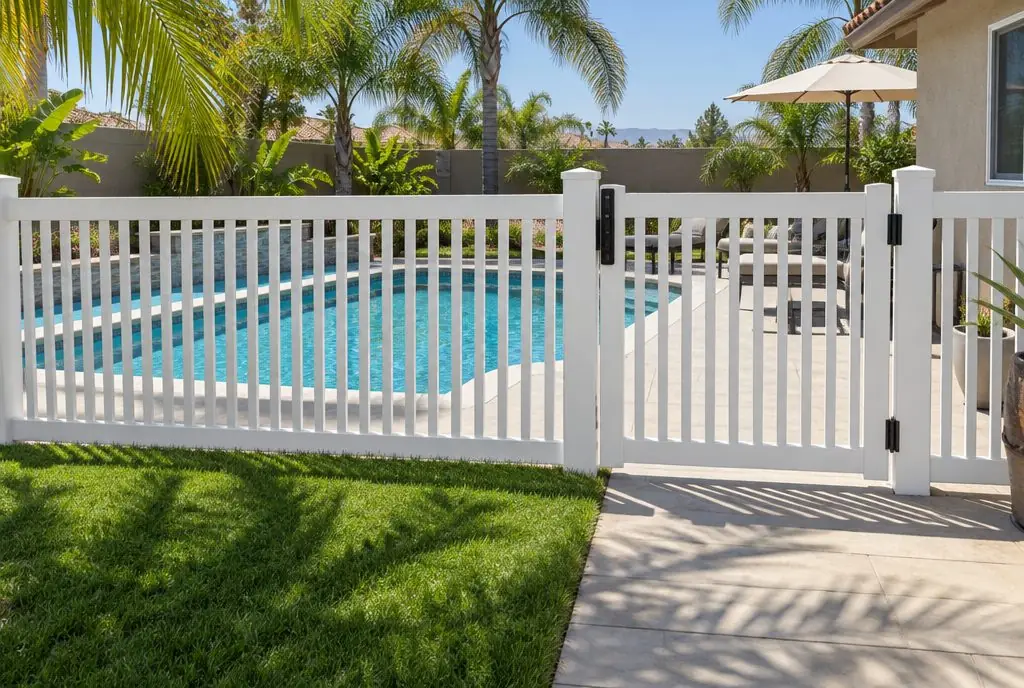
Santa Clarita Vinyl Fence covers pool fence installation for Santa Clarita Valley backyards — isolation fences around the pool and perimeter upgrades that bring a yard fence up to the barrier rules — where the installer builds a 60 inch climb-resistant vinyl barrier with the gaps, gate swing, hinges and latch height the California Swimming Pool Safety Act and the building code require.
 Illustration
What the California pool barrier rules actually say
The Swimming Pool Safety Act (Health and Safety Code 115920–115929) and the California Building Code pool barrier section set the dimensions. A barrier is at least 60 inches tall measured on the outside. Nothing bigger than a 4 inch sphere can pass through it, and the gap under the bottom rail is at most 2 inches. Horizontal members on the outside face must be at least 45 inches apart or the fence is climbable; vinyl picket panels with the rails on the pool side, or solid privacy panels, satisfy this. The gate opens away from the pool, closes itself, latches itself, and the latch release sits at least 60 inches up or on the pool side at least 3 inches below the top with no opening larger than 1/2 inch within 18 inches of it. New pools and remodels with permits in the SCV are inspected against these numbers, and the city's pool permit requires at least two of seven listed drowning-prevention features, of which a compliant fence is the most common.
| Dimension the Pool Safety Act describes | Figure |
|---|---|
| Barrier height, measured on the outside | At least 60 in |
| Openings anywhere in the barrier | A 4 in sphere must not pass |
| Gap between the bottom rail and grade | 2 in or less |
| Horizontal members on the outside face | At least 45 in apart, or the rails go on the pool side |
| Gate swing | Opens away from the pool |
| Gate closing | Self-closing and self-latching from any open position |
| Latch release | At least 60 in above grade, or on the pool side at least 3 in below the top |
| Openings near the latch | None larger than 1/2 in within 18 in of the release |
Vinyl styles that fit the barrier dimensions
5 ft picket with rails on the pool side
A 60 inch picket panel with 1.5–3 inch pickets on spacing under 4 inches, rails facing the water so there is no foothold from the yard side. The look stays open and the pool stays visible from the house.
5 ft or 6 ft tongue-and-groove privacy
Solid panels have no gaps at all and double as screening from a neighbor's second story. The outside face is smooth, so climbability is not an issue.
Semi-privacy with a lattice top
Allowed only if the lattice openings are under the sphere rule (most 1.75 inch lattice passes) and the lattice sits above 45 inches. The installer checks the actual panel before ordering.
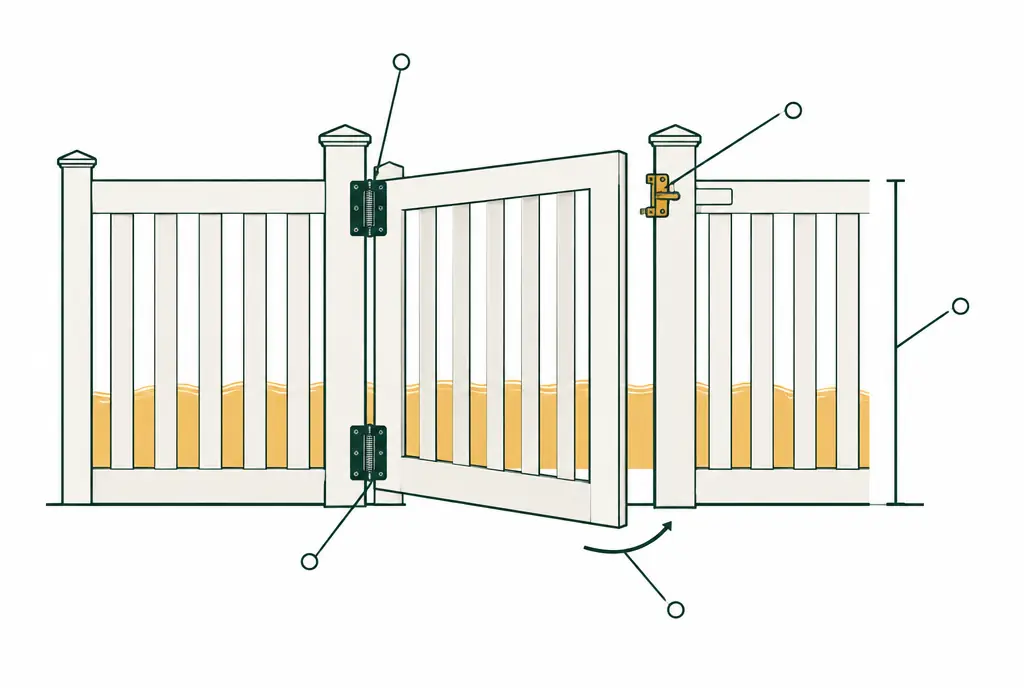
What the callout markers point to
- Spring-loaded hinges pull the gate shut from any open position; the latch catches on its own.
- The latch release sits high above grade so a small child cannot reach it from outside.
- The gate opens outward, away from the pool, and the picket spacing matches the rest of the barrier.
Gate hardware: self-closing hinges and magnetic latches
The gate is where most corrections are written at inspection. The post is 5x5 with a galvanized steel insert and a 30–36 inch footing so the gate never sags out of alignment with the latch. Hinges are adjustable-tension, self-closing stainless or polymer units (the Tru-Close type), set so the gate closes and latches from any open position including 6 inches. The latch is a top-pull magnetic latch (Magna-Latch style) mounted at 60 inches on the outside or on the pool side. Where an existing side-yard gate is being upgraded, the crew replaces the hinges and latch and confirms the gate swings outward from the pool.
Most pool-fence corrections are written at the gate, not at the panels.
A quick monthly check keeps the gate working the way it was set: open it 6 inches, let go, and confirm it closes and latches on its own.
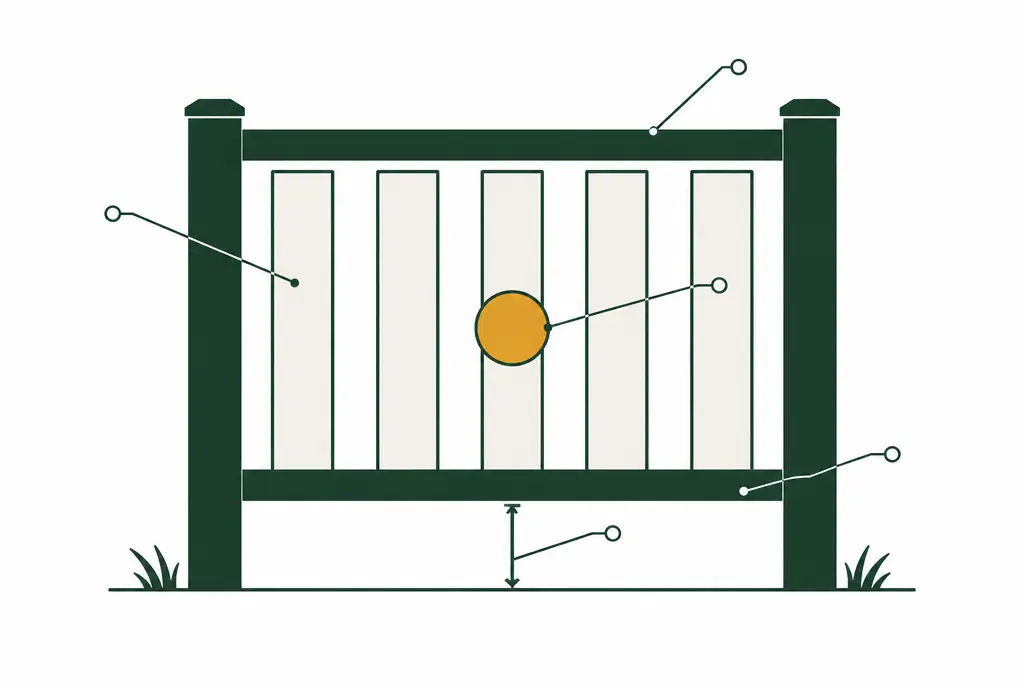
What the callout markers point to
- On a pool barrier the gap between pickets is held under the sphere test with a gauge block, not by eye.
- The clearance under the bottom rail is kept small so nothing can slip beneath the fence.
- The same even spacing on a front picket fence is what makes the run look straight from the street.
Pool fence layouts for Santa Clarita backyards
On the typical Valencia or Stevenson Ranch pad the pool sits close to the house and the perimeter fence already exists. The cheapest compliant layout is often a short isolation run — 40–80 ft of picket from the house wall to the side fences with one self-closing gate — rather than rebuilding the perimeter. Sliding doors from the house into the pool area are a separate requirement and are usually handled with door alarms or a second feature from the city's list. Larger Sand Canyon and Castaic lots where the pool is away from the house get a full four-sided enclosure with two gates.
Inspections and the isolation versus perimeter choice
A perimeter fence makes the whole backyard the pool area, so every yard gate has to meet the gate rules and the house doors need their own protection. An isolation fence makes a smaller zone around the water and leaves the rest of the yard free. The installer lays out both on the site walk; isolation fences cost less and draw fewer corrections, and a permit is typically required for a new or replaced pool barrier tied to a pool permit. Whether a yard meets the pool-barrier rules is decided at inspection by City of Santa Clarita Building and Safety (or LA County for unincorporated areas) and depends on the whole enclosure — house doors, alarms and gates — not on the fence alone.
Vinyl Pool Fence (Pool Code Barrier) — common questions
How tall does a pool fence have to be in California?
60 inches on the outside, with no gap over 4 inches anywhere, no more than 2 inches at the bottom, and no climbable horizontals on the outside face.
Can the existing 6 ft vinyl privacy fence serve as the pool barrier?
Often, yes, as long as the gates in it close and latch themselves, swing away from the pool and have the latch at 60 inches. Upgrading the gate hardware is usually the only change; the inspector decides for the whole enclosure.
What does a pool fence cost in Santa Clarita?
About $40–$60 per foot installed for a 5 ft climb-resistant vinyl barrier in 2026, plus $350–$650 per self-closing walk gate. A short 60 ft isolation run with one gate lands roughly between $2,750 and $4,250.
Vinyl Pool Fence (Pool Code Barrier): check availability and price range
Bookings aren't open yet — describe the fence line and you get a Santa Clarita price range right here. Per-foot ranges are typical Santa Clarita Valley installed prices for white vinyl, materials and labor. This is a market estimate, not a quote; footage is measured on site and the installer prices the actual job. City permit fees and HOA fees, where they apply, are not included.