
Santa Clarita Vinyl Fence: Project example: 180 feet of rotted dog-ear wood fence replaced with 6-foot vinyl privacy fence in Saugus — what it looks like and what it costs
Santa Clarita Vinyl Fence takes a typical replacement project for a single-story Saugus ranch home: 180 linear feet of leaning dog-ear redwood fence with rotted posts along three sides of a flat backyard, pulled out with its footings and replaced with a 6-foot white vinyl privacy fence on new posts, sharing two of the three lines with neighbors.
Project Examples & Typical Prices
Worked example. The pictures are AI concept illustrations, not photographs; no installation was performed or arranged through this site; prices are typical Santa Clarita Valley market ranges, not quotes.
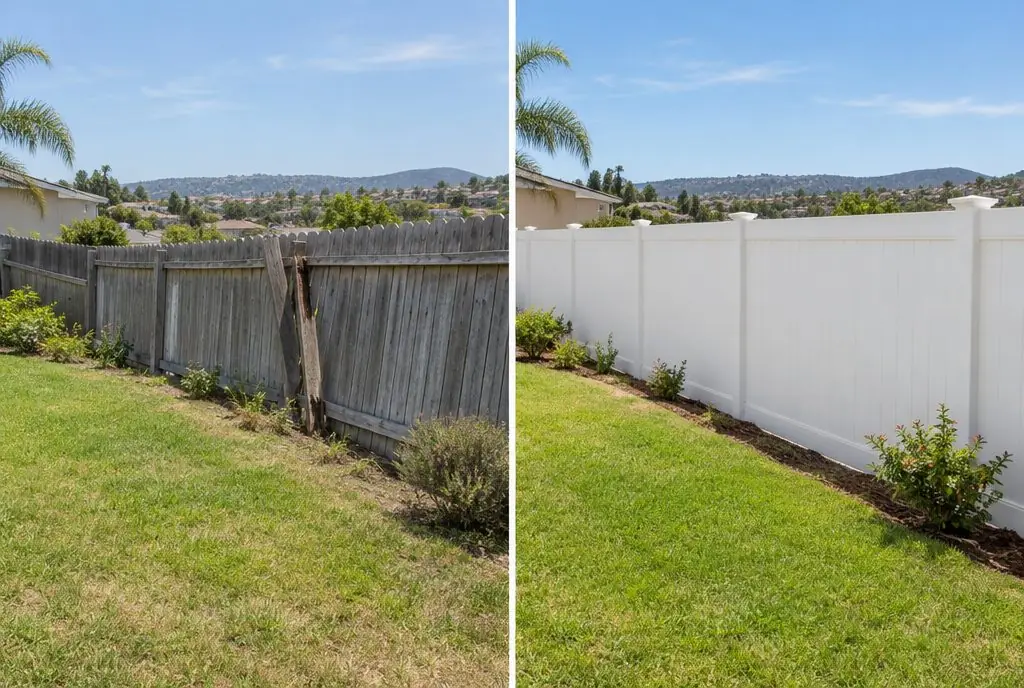 Illustration
Starting pointFinished layout (concept)
Illustration
Starting pointFinished layout (concept)
The scenario
The house is one of the single-story ranch homes built across Saugus in the decades after the valley's first tracts went in: a flat rectangular backyard about 60 feet wide and 60 feet deep, a concrete patio off the family room, and a dog-ear redwood fence on three sides that has been patched more than once. Two of the posts along the back have rotted off at grade and the panels there lean a foot into the yard, held up by a diagonal 2-by-4. Termite damage shows at the bottom of several pickets, and the gate to the side yard drags on the concrete.
The two side lines are shared with neighbors on either side, and the back line borders a third property, so the plan is talked through over the fence before anything comes down. The brief is a 6-foot white vinyl privacy fence on all three sides, the old fence and its concrete footings fully removed and hauled away, and the existing 4-foot side gate location kept. The ground is flat with lawn on both sides of the line, and the soil is the sandy loam that makes Saugus yards easy to dig but not always firm enough for a post without a good footing.
What the old fence shows on the first walk of the line:
- two rear posts rotted off at grade, with the panels propped on a diagonal 2-by-4
- termite damage at the foot of several pickets along the back
- a side gate that drags on the walkway concrete
- original concrete footings of varying size under every post
What the job involves
- The installer walks the three lines with the neighbors' positions confirmed, marks the existing post centers, and arranges utility marking; the sprinkler heads near the fence are flagged so the auger stays clear.
- The old fence comes down panel by panel: pickets and rails are pried off, the posts are cut at grade or rocked out, and each concrete footing is dug out or broken with a demolition hammer so the new post holes are not blocked.
- Demolition debris is sorted into a trailer or dumpster — redwood to green waste where accepted, concrete and hardware separately — and the fence line is raked clean before layout.
- A string line is run at the finished top height along each side, new post centers are marked at 8-foot spacing starting from the house corner, and the side gate opening is set at the same position as before so the walkway still works.
- Holes are augered about 10 inches wide and 30 inches deep, with gate and corner posts going to 36 inches; the sandy soil gets a gravel base so the concrete does not sit in standing water during a winter rain.
- Posts are set in concrete and plumbed to the string, left to cure, and then rails with aluminum inserts and tongue-and-groove pickets go in panel by panel; the side gate is hung on a reinforced post with adjustable hinges and a latch.
- Flat caps are glued on, the lawn edge is backfilled where the old footings came out, and the patio and both neighbors' sides are swept of shavings and concrete crumbs.
Hardware and materials
- 5-by-5 inch white vinyl posts routed for 6-foot privacy panels; bottom rails with aluminum inserts, top rails, tongue-and-groove pickets in 8-foot panels
- One 4-foot welded-frame vinyl walk gate with a reinforced gate post, adjustable hinges and a gravity latch
- Demolition hammer, reciprocating saw, pry bars, and a trailer or dumpster for the old redwood, concrete and hardware
- Fast-setting concrete and gravel for about two dozen post holes; auger with a 10-inch bit; string line, post levels and braces
- Flat external post caps and vinyl-safe adhesive
- Lawn repair soil for the strip where the old footings are removed
What it typically costs in the Santa Clarita Valley
| 6 ft solid privacy, 180 linear feet installed ($38–$58 per foot) | $6,840–$10,440 |
| Remove and haul away an old fence (+$4–$8 per foot) | +$720–$1,440 |
| Typical total | $7,560–$11,880 (market range, not a quote) |
These are typical local ranges, not a quote or an offer; an installer prices the actual job after seeing the wall.
Add-ons often paired with this job
- Single walk gate (4 ft) — +$350–$650. A second gate on the far side yard is the most common addition on a three-sided replacement, priced as its own option.
- Decorative post caps (per run) — +$60–$180. Decorative caps along a long straight run are a small upgrade that changes how the fence reads from the patio.
- Tan, gray or woodgrain vinyl instead of white — +$300–$900. Where a neighbor's existing vinyl is tan, matching it on the shared line keeps both yards consistent at a material surcharge.
Why it is done this way
Pulling the old footings rather than setting new posts beside them is what keeps the new fence on the existing fence line and the post spacing even. Vinyl panels come in fixed lengths, so posts have to land where the panels say, not where the old concrete happens to be. Removing a footing is slower than digging fresh ground, which is why removal is priced per foot on top of the base rate.
A 6-foot solid privacy fence on a flat Saugus lot is the simplest vinyl project there is, and the reason it still takes two days is the footing work: each post goes into concrete deep enough to hold a tall panel in a Santa Ana wind, and the aluminum insert in the bottom rail keeps the panel from bowing in July heat. Vinyl is chosen here precisely because of what failed on the wood fence — there is nothing to rot, nothing for termites to eat, and nothing to paint.
Wood versus vinyl on this yard, in the terms that matter after a few summers:
- Rot and termites: the failure that ended the old fence does not apply to vinyl.
- Upkeep: vinyl is low-maintenance, washed down with a hose; redwood needs stain or sealer every few years.
- Heat: UV-stabilized white vinyl resists fading, though white panels can chalk over time.
What would change the price
- The old posts were set in oversized footings — breaking out large concrete blocks adds labor and haul-away weight at each post.
- The neighbors share the cost of a line — the owner's share of the fence changes, but the per-foot rate does not.
- Sprinkler lines run along the fence and get cut during footing removal — repairing them is a separate item, usually by the irrigation side.
- The side gate is upgraded to a 5-foot opening for a mower or trash cans — a wider gate frame and a heavier post change the gate line.
- The back line needs to be taller for privacy from a two-story house — an 8-foot fence usually needs a permit and heavier posts, which moves the whole base rate.
Where this leads
- Service page: Wood-to-Vinyl Fence Replacement — Old fence out, footings broken, everything hauled, new vinyl posts in fresh ground — the standard SCV backyard job.
- Local page: Vinyl fence installation in Saugus
- All services and typical prices: vinyl fence installation in Santa Clarita
- More worked examples: Project Examples & Typical Prices
Check availability and the price range for this setup
Bookings aren't open yet — describe the fence line and you get a Santa Clarita price range right here. Per-foot ranges are typical Santa Clarita Valley installed prices for white vinyl, materials and labor. This is a market estimate, not a quote; footage is measured on site and the installer prices the actual job. City permit fees and HOA fees, where they apply, are not included.